How is existence connected?
From the source of creation to consciousness and the physical body: how might a layered view of the universe change our understanding of our place within it?
A philosophical journey into the universe, consciousness, and the self.
From cosmic origins to everyday thought: choose a question that draws you in and discover a place to begin.
Explore “Distinguishing,” “Heartbeat,” and “Stillness,” the methods introduced in the published book.
CHOOSE ANOTHER QUESTION ↑Where did the universe begin?
What is consciousness?
And what is the “self” experiencing this world?
CosmOS is a philosophical framework that approaches the universe, consciousness, and everyday choices as interconnected questions. From the visible world to the structures beneath it, it explores our relationship with existence through reflection.
Let this page be the beginning of that journey.
The origins of the universe.
The way we live this moment.
Two inquiries, considered together.
CosmOS seeks to develop an integrated cosmology encompassing both theory and practice. It brings the Creator, cosmic hierarchies, and the structure of consciousness into the same framework as thought, memory, free will, and everyday choices.
The author sees the breadth of this integration as the book’s distinctive contribution. Connecting scientific and spiritual questions, and cosmic origins with individual experience, it attempts to offer new interpretations of both life’s problems and puzzles in physics.
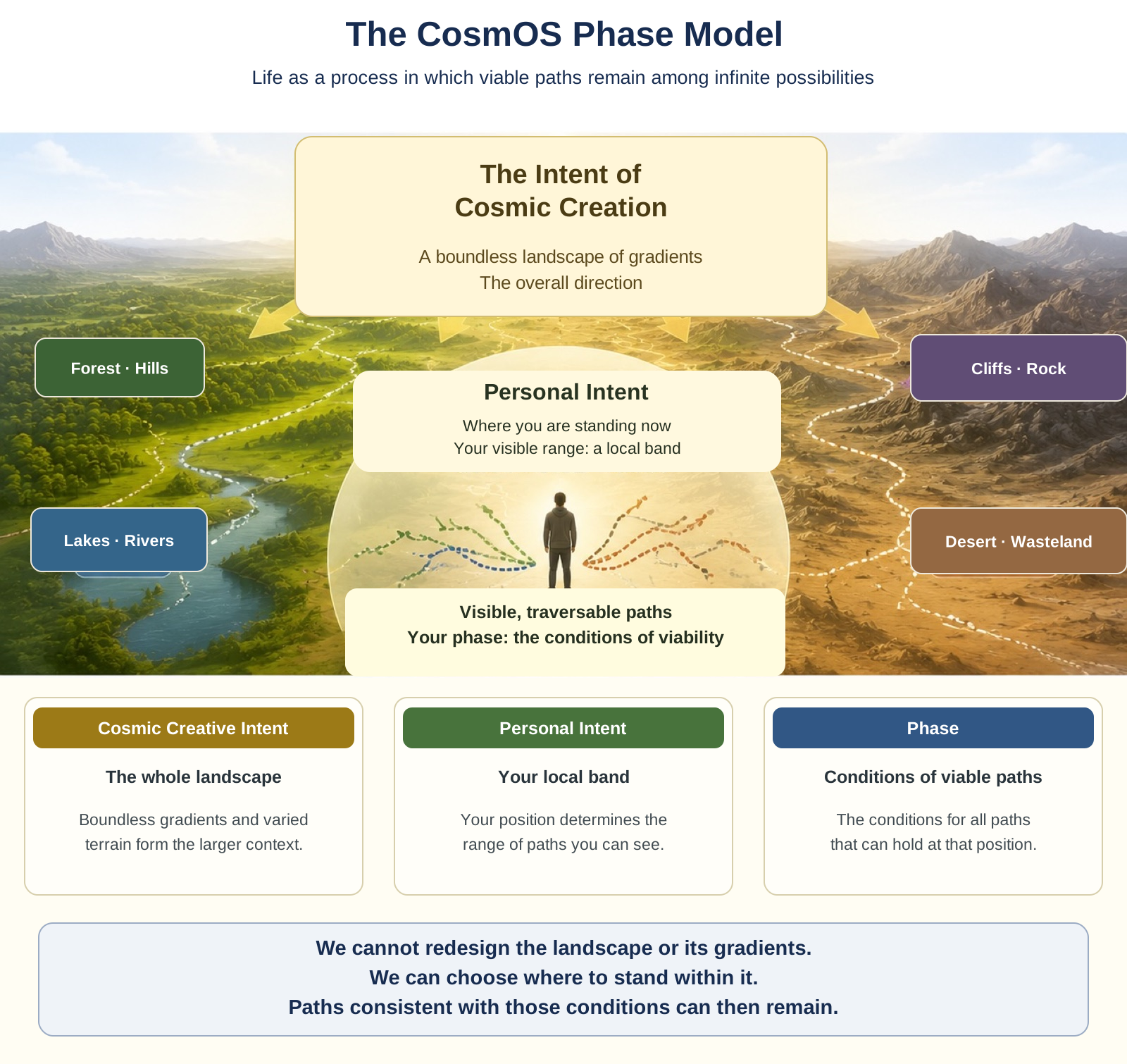
From the source of creation to consciousness and the physical body: how might a layered view of the universe change our understanding of our place within it?
“Phase” is a central concept in CosmOS. Through it, we consider how the self relates to the world.
To reconsider free will is to reconsider how we live in the present. Explore everyday choices from a different perspective.
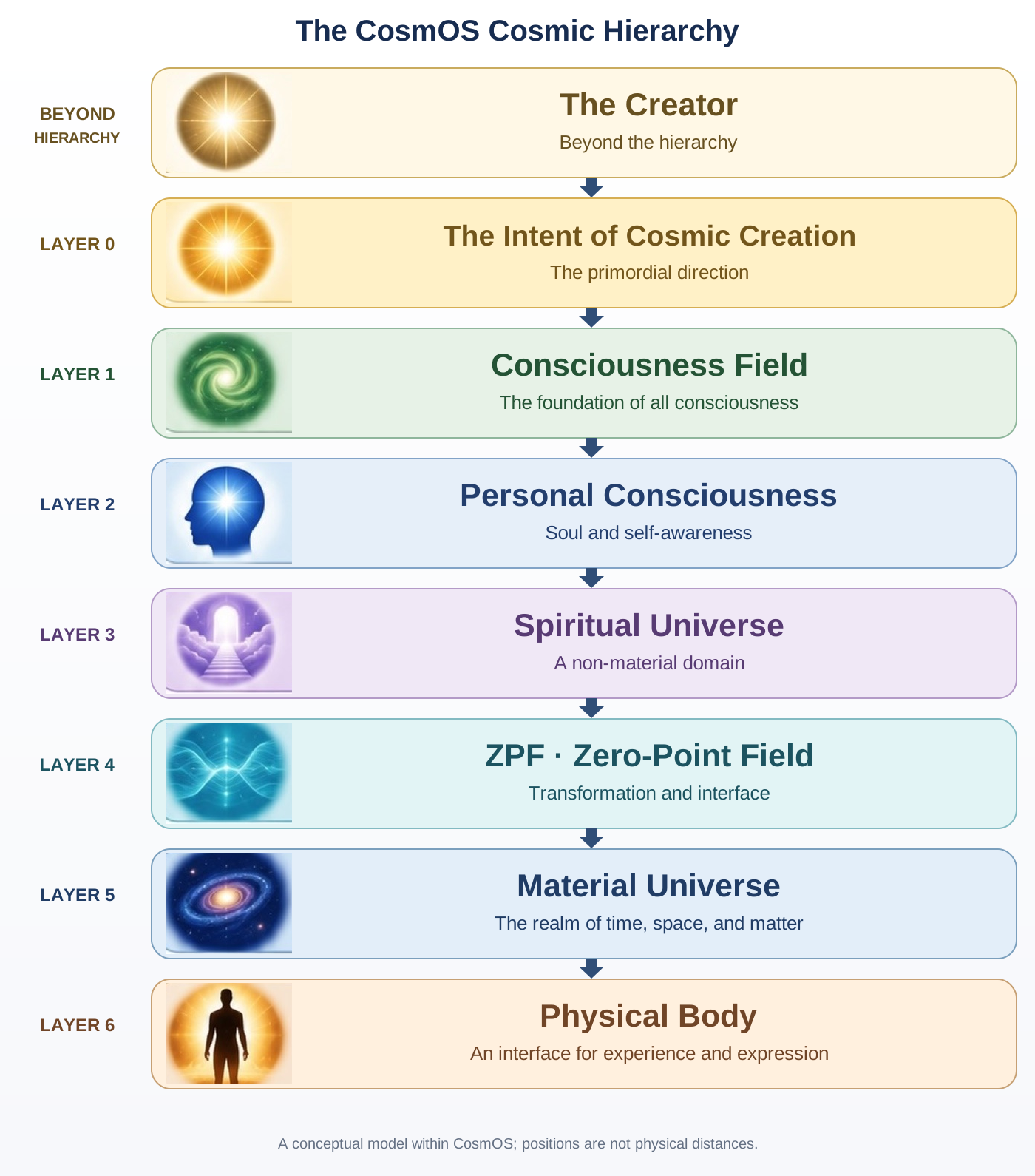
Explore the relationships CosmOS proposes. Select a layer to read its role and discover a related chapter.
The source of individual consciousness
A spiritual hypothesis within CosmOS
A field proposed as the source of consciousness, encompassing both spiritual and material universes. Individual consciousness is understood as its local expression.
Chapter 2 describes the consciousness field and individual consciousness as different aspects of the same layer. The ocean-and-wave metaphor expresses continuity and localization.
CHOOSE ANOTHER LAYER ↑A hypothetical CosmOS model based on Chapter 2 of the published edition. The Creator is beyond hierarchy; creative intent is Layer 0. Layers 1 and 2 are different aspects of the same layer, separated for explanation. Positions do not represent physical distance or superiority.
Eight possibilities explored in the book.
Begin with the question that matters to you.
Why do the same thoughts return again and again? Reconsidering the structure of thought and consciousness may open a different perspective on being caught in repetitive thinking.
An event in the past, and the self experiencing its memory now. Reconsidering that relationship may change how we relate to distressing memories.
How do we locate ourselves within the universe? A change in perspective may reach into the meaning of everyday events and the experience of living itself.
Intent, manifestation, and phase. Explore what the book calls “the complete law of attraction” within its integrated cosmological framework.
Does God exist, and what might that mean? Questions about the Creator and the intent behind cosmic creation open an inquiry into the source of existence.
Where might a sustained inquiry into existence lead? Consider the logical implications of an ultimate destination, and eternity as an infinite hierarchy.
The field of consciousness, ZPF, causality, and cosmic structure. A framework spanning scientific and spiritual perspectives offers alternative interpretations of difficult questions.
How might cosmology inform everyday choices and relationships? Reflect on ways of living through alignment with intent and through altruism.
These are possibilities the book explores, not guarantees of particular outcomes or scientific validation.
In CosmOS, phase is more than a change of mood or mindset. It concerns the conditions under which events appear and the state of the whole self. These everyday illustrations connect with specific passages in the published book.
“Phase” is a prerequisite for all events to appear in the way they do.
Translated from Chapter 17, section 17.5. The scenarios below are website illustrations based on Chapters 21, 23, and 24.
“That remark proved I had no worth.” The event and the interpretation held by the person you were have become inseparable.
“How might this look if I stepped back and observed the person who received that remark?”
Chapter 21 introduces Observer Perspective as viewing oneself as a character from a step back. It then moves toward Reinterpretation: reconsidering present interpretations rather than altering past events.
Chapter 21, sections 21.7, 21.13, and 21.14
READ THE RELATED INTRODUCTION ↓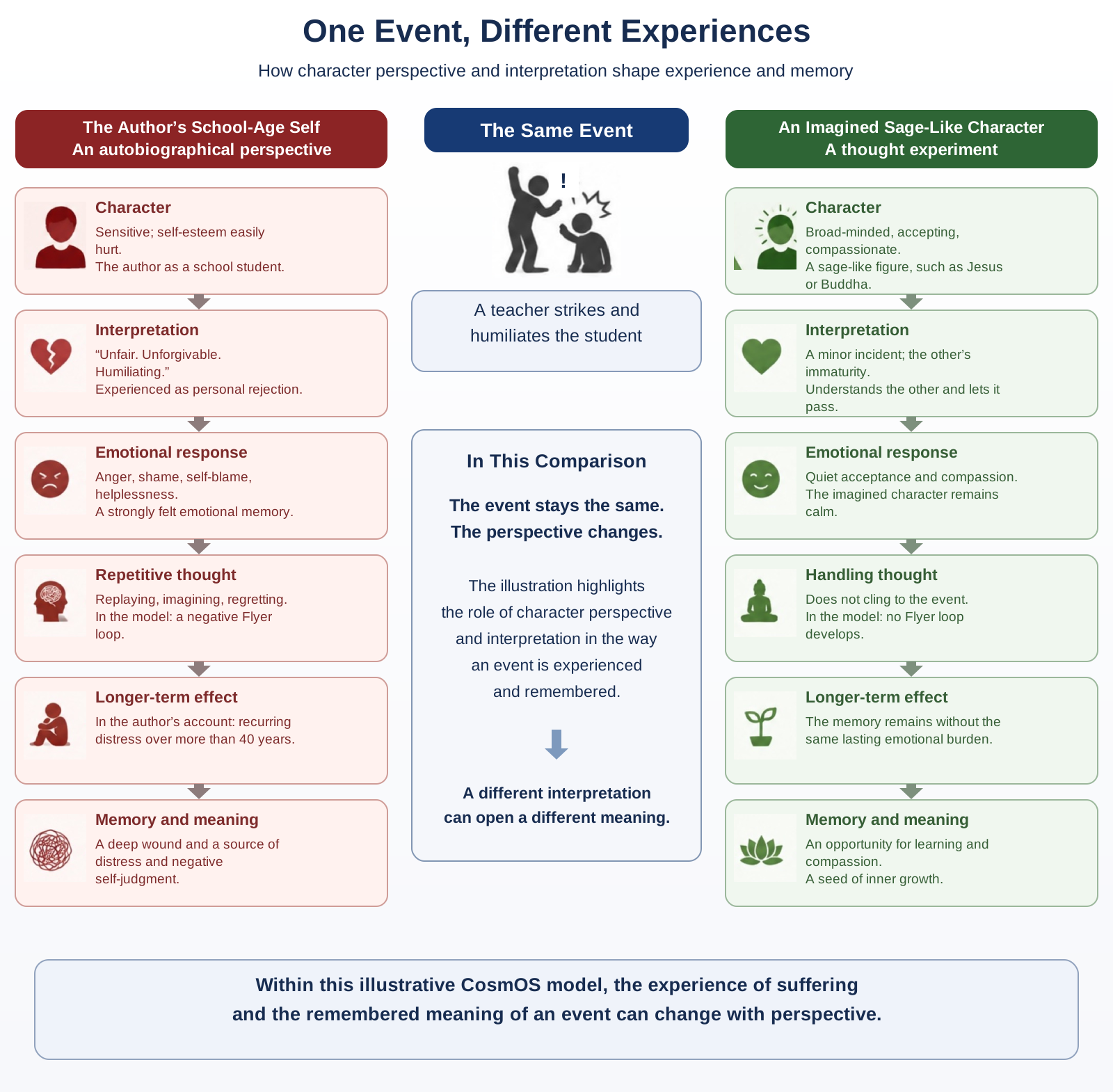
Chapter 21 advises readers who experience PTSD symptoms not to undertake its Reinterpretation method. This page introduces the ideas, rather than giving the exercise’s instructions.
“I need better results while remaining exactly who I am.” Words, actions, and inner beliefs may conflict with the desired result.
“Who am I appearing as in the world? Am I acting as someone who helps others clarify problems and move forward?”
Chapter 24 explains phase transition as an update to self-definition. Within its model, alignment involves action, inner attitudes, and practical conditions as well as words.
Chapter 24, sections 24.2, 24.4, and 24.6
READ THE RELATED INTRODUCTION ↓“When will I get it? Why hasn’t it happened?” Pursuing an outcome becomes entangled with comparison or a strained presentation of the self.
“What value am I contributing to the world?” “Am I natural right now?”
These are the two questions presented in Chapter 23. They shift attention from acquiring outcomes toward contributing value and a natural way of being: an introduction to the book’s inquiry into coherence among intent, action, and state of being.
Chapter 23, sections 23.7, 23.10, and 23.11
READ THE RELATED INTRODUCTION ↓Move the slider to change the phase difference between two waves. Watch them align, overlap, and drift apart as their relationship changes.
The control changes the phase difference between two periodic waves. In CosmOS, “phase” refers to a higher-order coordinate system governing how the world appears and which choices are possible; it is not the same quantity as the angle shown here. The waves offer a metaphor for changing relationships.
From Chapter 1 of the published Japanese edition. CosmOS begins by questioning the existence of the universe itself.
Why does the universe exist at all?
Why is there something rather than nothing?
And why do we exist?
CosmOS attempts to offer a comprehensive way of seeing the world, logically integrating science, philosophy, and spiritual cosmology in response to these questions.
Translated excerpts from Chapter 1 of CosmOS, Volume I, published Japanese edition. Note numbers are omitted.
READ THE CHAPTER 1 INTRODUCTION ↓CosmOS connects several domains of inquiry. Follow the argument while keeping the basis of each kind of explanation in view.
Passages refer to physics, cosmology, neuroscience, and other fields. Referring to scientific knowledge is different from empirically validating the CosmOS model as a whole.
The Creator, consciousness field, spiritual universe, and integration through phase belong to the book’s hypotheses and interpretations. Trace their premises and the reasoning that connects them.
A transparent birdcage, the body as a terminal, and overlapping waves help illustrate aspects of a structure. An analogy by itself is not proof of a cosmology.
From the source of creation to the structure of consciousness. From thought and everyday life to reintegration through phase. Across 25 chapters, the book connects theory with practice.
Select a chapter to open its introduction. Follow the question that draws you in.
These introductions summarize the published Japanese edition; they are not direct excerpts.
Preface
Why is there something rather than nothing, and why do we exist? Assuming a Creator, CosmOS develops a picture of the universe through self-projection and the intent of cosmic creation, establishing the foundations for all 25 chapters.
From the Creator beyond hierarchy and creative intent at Layer 0, through the consciousness field, individual consciousness, spiritual universe, ZPF, material universe, and physical body: a map of existence connected through containment, influence, and projection.
Is consciousness a byproduct of the brain, or connected with the foundations of the universe? Referring to subjective experience and consciousness research, CosmOS defines its consciousness field while distinguishing scientific knowledge from spiritual hypotheses.
What makes yesterday’s self the same as today’s? Thought experiments about personal identity lead into individual consciousness as a local expression of the consciousness field. The chapter explores soul, spirit, and physical body, and their two-way connections across the hierarchy.
The spiritual universe is considered as a continuum of differing states rather than fixed steps. The electromagnetic spectrum serves as an analogy while the chapter distinguishes what can be approached by analogy from what remains unknowable.
Vacuum fluctuations, zero-point energy, and the Planck length provide the scientific references. CosmOS then proposes ZPF as an interface between spiritual and material universes. The scientific account and the additional interpretation are treated as distinct.
Could cosmic dissolution lead to a new beginning? Referring to conformal cyclic cosmology and the Big Bounce, CosmOS proposes that only the material universe cycles, while ZPF and higher layers do not. It reconsiders entropy, initial conditions, and meaning within that model.
How does human intent relate to the intent of cosmic creation? Using probability structures and the butterfly effect as analogies, the chapter considers wishes, underlying beliefs, and constraints, approaching unsuccessful wishing as a structural question.
Creative intent is proposed as a fundamental condition for a universe to exist. The chapter explores its infinite range and a structure encompassing cosmic origins and eventual form. “Before” here means a prerequisite of existence, rather than an earlier moment in time.
Earth’s ecosystems are examined through predation and parasitism. Examples of host influence lead to questions about humans as participants in, rather than exceptions to, the ecosystem. These provide structural analogies for the hypotheses that follow.
Castaneda’s “Flyer” and Monroe’s “loosh collectors” are brought into a spiritual explanatory model for repetitive thought and negative inner dialogue. The chapter does not claim scientific verification or establish the literal existence of such entities.
Biological parasites, collective thought, lower spirits, and society are considered within a hypothesis of multilayered influence. The purpose is a framework for examining influence and agency, rather than intensifying fear.
The first method, “Distinguishing,” addresses identification with thoughts. Within the book, the Flyer label is used operationally to loosen that identification and return attention to the present, rather than to establish the cause of a thought.
From memories and anticipated worries toward present sensation: “Heartbeat,” the second method, centers on breathing and sensing one’s own pulse. It explains where attention returns after distinguishing thought, through the CosmOS idea of alignment with creative intent.
Why does unwanted inner speech continue? Scientific descriptions of the default mode network are distinguished from the CosmOS Flyer hypothesis. The third method, “Stillness,” connects with altruistic intent and a proposed transition toward creative activity through TPN.
Altruism is interpreted as resonance with the direction of cosmic creative intent. From the few meters around us to society, Earth, and the universe, the chapter considers altruism as an orientation of development and alignment, rather than an imposed demand for sacrifice.
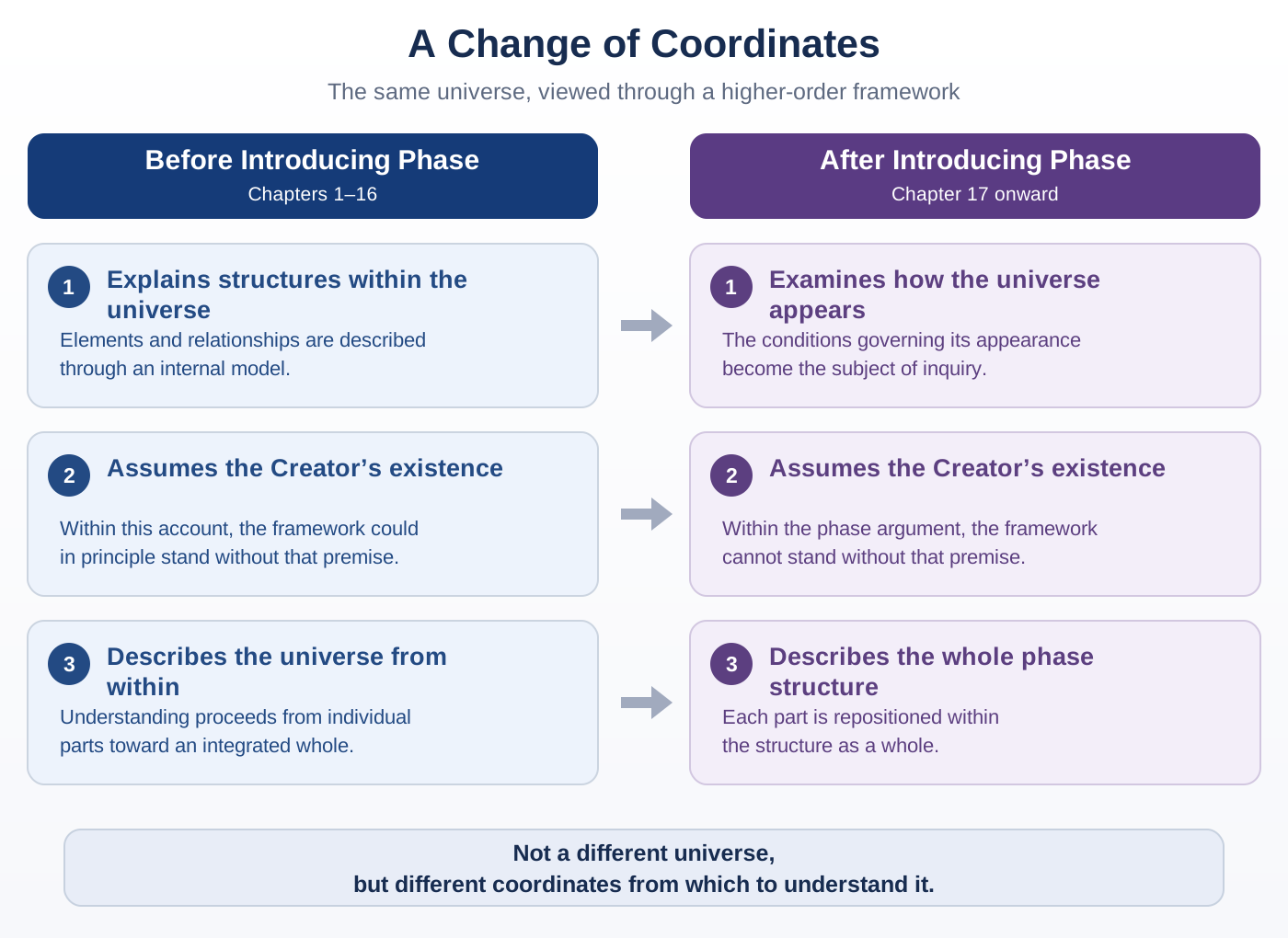
A turning point that retains the preceding worldview while changing the coordinates from which it is seen. Phase is introduced as a prerequisite governing how things appear, followed by an inquiry into why its ultimate source cannot be explained entirely from within the universe.
“The universe is phase unfolded from the intent of cosmic creation.” From this perspective, the consciousness field, spiritual universe, ZPF, and material universe are reintegrated. The chapter explores root phase and creative intent, reinterpreting hierarchy beyond an assembly of separate parts.
The individual is compared with a wave formed by the ocean, rather than a drop detached from it. Consciousness, qualia, and thought are reconsidered through phase. Free will is defined as a local action changing alignment, involving the state of the whole self rather than thought alone.
How are past, present, and future experienced within the universe? References to the block universe, time, the double-slit experiment, and many-worlds interpretation are reread through phase. Experimental findings and CosmOS interpretations remain distinct.
The fourth method, “Observer Perspective,” leads to “Reinterpretation” and “Happy Ending!” Events themselves are distinguished from present interpretations of them, and the relationship with memory is reconsidered through the book’s perspectives on karma and growth.
Why do altruism, goodness, and the search for meaning persist? Evolution is reconsidered in terms of phase stability, connecting altruism and meaning with direction. Reality is interpreted as a dynamic center of balance or stable point within the model.
From wish fulfillment to phase alignment: “What value am I contributing to the world?” and “Am I natural right now?” The chapter uses these two questions to examine coherence among intent, action, and one’s state of being, rethinking attraction beyond manipulating outcomes.
Within this model, reality is not simply selected: coherent, viable paths remain. Phase transition is explored as an update to self-definition, connecting the intent of who one appears as in the world with how one actually lives.
Where do we come from, and where are we going? Individual uniqueness and the whole, forgetting, suffering, finitude, love, and spiral development are reconsidered through creative intent. The inquiry extends to absolute infinity and an unknowable unmanifest domain.
Afterword / Appendices 1, 2, and 3
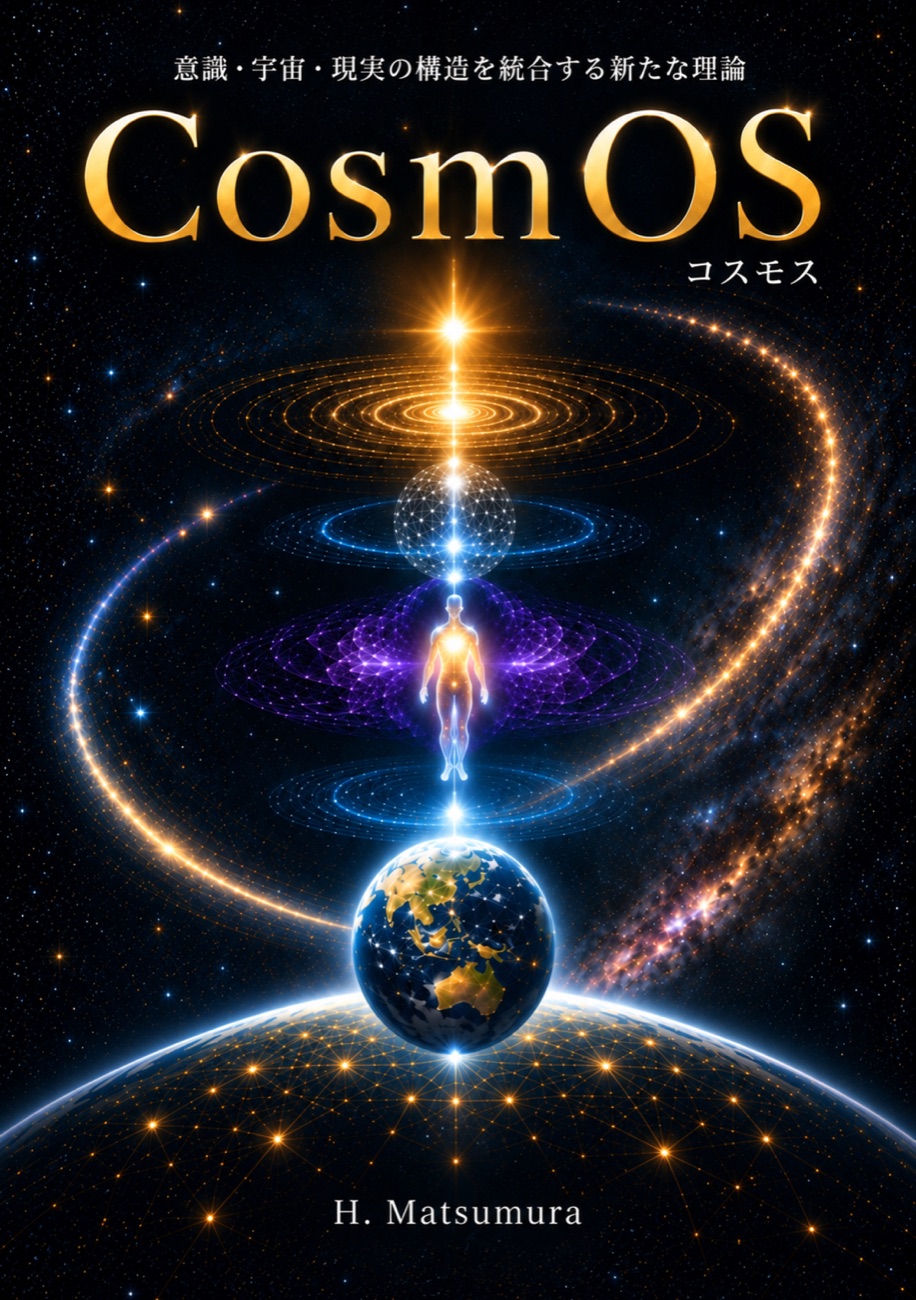
H.Matsumura
VOLUME I / CHAPTERS 1–25 / JAPANESE EDITION
From cosmic origins to everyday choices.
25 chapters connecting theory and practice.
Begin with the Creator and cosmic hierarchies, then explore consciousness and everyday life. Chapter 17 introduces phase, leading toward free will, causality, attraction, and infinite hierarchy.
Start with Chapter 1 for the foundations. To follow a personal question first, use “Your question” near the top of this page to discover related chapter introductions.
The waves are a visual metaphor. Their phase difference is distinct from the higher-order coordinate system CosmOS calls “phase.”
This website has an English page, but the linked Amazon product is the Japanese edition. The English website does not indicate an English edition of the book.
Content is based on the published Japanese edition and author-supplied materials. The four explanatory figures are adapted into English; the cover shows the Japanese edition.